The Beatles, Little Richard and the Leiber-Stoller classic ‘Kansas City’
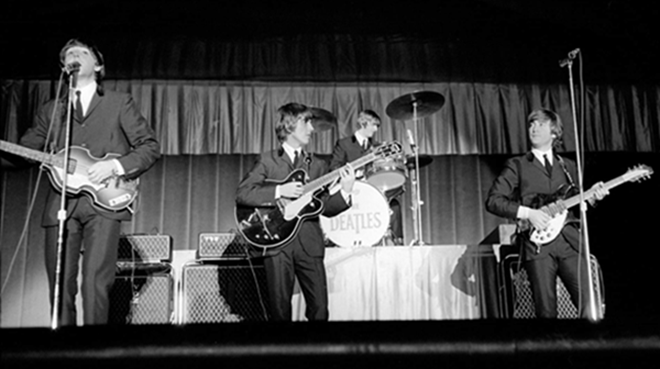
The Beatles’ version of the R&B standard Kansas City is well known from its appearance on their 1964 album Beatles For Sale. Basically a copy of Little Richard’s very free interpretation of the song, which was a minor hit in the UK in 1959, Kansas City had been part of the Beatles’ repertoire for several years,1 and in September 1964 during their North American tour they performed the song to “an especially uproarious reception” at a concert in Kansas City itself.2
With a Christmas deadline for their next LP approaching, and unable to come up with enough original material for an entire album due to their relentless touring schedule, the Beatles resorted to recording songs from the stockpile of cover versions they had accumulated during their earlier years in Liverpool and Hamburg. Given the response at the US concert, Kansas City was an obvious choice, and it was one of seven recordings completed in a single session on 18 October.3 The track was no mere filler, though. Featuring Paul McCartney’s convincing Little Richard impression (also employed to good effect that year in performances of Long Tall Sally) Kansas City is described by Ian MacDonald as “one of the Beatles’ best covers”.4
When Beatles For Sale was released, and for years afterwards, the composer’s credit for Kansas City went to “Leiber-Stoller”. But anyone buying the album today will find that the track has been recategorised as a “medley”, made up of two different copyrighted songs – Kansas City itself and another composition titled Hey-Hey-Hey-Hey, which is credited to Richard Penniman, better known as Little Richard.5 Most commentators, including Beatles experts such as Mark Lewisohn and Ian MacDonald, have endorsed the characterisation of the song as a medley, and despite its questionable accuracy this has now become the commonly accepted view. To work out how that happened, we need to trace the history of the song, which is an intriguing subject in itself.
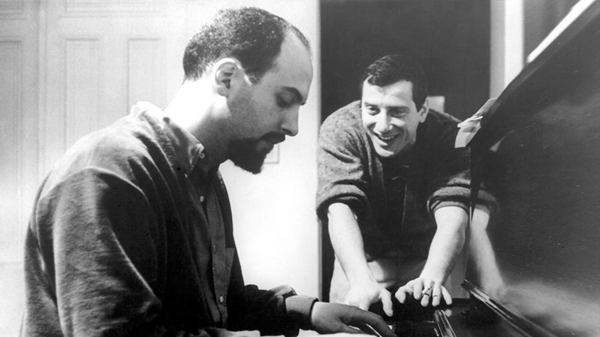
The Leiber-Stoller in question were Jerry Leiber and Mike Stoller, two white R&B enthusiasts from New York, who over the course of the 1950s and early ’60s established themselves as leading songwriters in that essentially African American musical genre. Kansas City was one of their first compositions, and it’s an interesting piece. Although it is structured like a 12-bar blues, Mike Stoller insisted – against Jerry Leiber’s objections – that they should avoid using a traditional blues tune. Instead Stoller contributed a distinctive melody of his own.6
The song was first recorded by Little Willie Littlefield in 1952 for the King Records subsidiary Federal (although for this release it was retitled K.C. Loving, which Federal boss Ralph Bass thought sounded “hipper”). Stoller observed that Kansas City “became one of our most recorded tunes, with more than three hundred versions out there”.7 But the Littlefield original was not a hit, failing to register at all on the Billboard R&B chart. The song’s unconventional character may well explain this failure – African American record buyers of the period probably expected their blues records to sound like the blues. Stoller’s more melodic approach would later help extend the song’s appeal to a white audience, but in the early 1950s very few R&B artists managed to crossover into the mainstream pop charts, and Littlefield was no exception.
Despite underperforming commercially on its initial release, Leiber-Stoller’s song evidently made an impact on Little Richard. In 1955 the nascent rock’n’roll star recorded two versions of Kansas City for Art Rupe’s Specialty label – first in September in New Orleans, during the same two-day studio session that produced his breakthrough hit Tutti Frutti, and then again in November in Los Angeles.
On the New Orleans recording Little Richard began by singing two verses from the Little Willie Littlefield version, before abandoning Jerry Leiber’s carefully constructed lyrics and veering off into a vocal improvisation more in keeping with his preferred style, in which the words of a song served a simple functional purpose and literary sophistication was a distraction. (“Well bye, bye bye baby bye/Wooo so long, bye bye baby I’m gone/Well bye, bye bye baby bye” etc.)
Art Rupe decided that with some more work this could be a hit single, and so he arranged for Little Richard to travel to L.A. two months later to re-record it. For his second attempt at Kansas City, Little Richard further revised Leiber-Stoller’s song by incorporating some even less coherent lyrics of his own. (“It’s just a one, two, three, four, five, six, seven, eight, nine”.) Crucially, that recording also included a “Hey, hey, hey, hey” call-and-response section that wasn’t part of the Little Willie Littlefield original.
It was Little Richard’s L.A. recording of Kansas City that later provided the direct inspiration for the Beatles’ version. But neither of his 1955 variations on the Leiber-Stoller song was released at the time. It appears that Art Rupe, who was always on the lookout for a money-making opportunity, reasoned that significant changes had already been introduced to the original, and if a few more alterations were made it could be passed off as an entirely new composition. Which is what happened.
In 1956 Little Richard recorded a third variation of the song, under the title Hey-Hey-Hey-Hey, which featured the refrain from the as yet unissued L.A. recording. He also added some more new lyrics, removing any reference to Kansas City as the intended destination of the song’s protagonist. Whereas the Leiber-Stoller song had begun “I’m going to Kansas City, Kansas City here I come”, Little Richard replaced it with “Going back to Birmingham, way down in Alabam’”. Even though this verse was obviously derived from Kansas City, it was Little Richard alone who received the composer’s credit for Hey-Hey-Hey-Hey.8
His publishing company – the Rupe-owned Venice Music – must have earned sizeable royalties from the song, because Hey-Hey-Hey-Hey was released in 1958 as the B-side of Little Richard’s big hit Good Golly, Miss Molly (#4 on the Billboard R&B chart, #10 on the Top 100). If they had adopted Art Rupe’s single-minded pursuit of profit, Leiber and Stoller could have demanded a cut of the proceeds, because the opening verse of Hey-Hey-Hey-Hey was based on their own song. But they took no action.
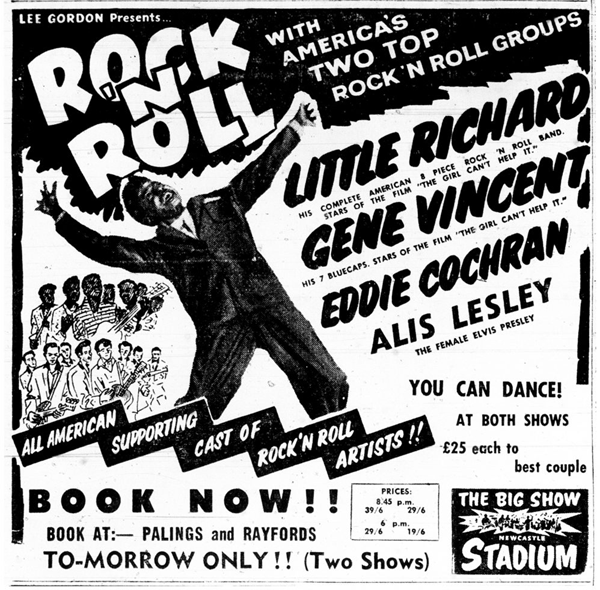
By the time Good Golly, Miss Molly hit the charts Little Richard had retired from the popular music industry, claiming to have experienced a religious epiphany during his October 1957 Australian tour, which led him to embrace born-again Christianity. On completing training for the ministry he dedicated his life (well the next five years of it anyway) to preaching the gospel, as the Reverend Richard Penniman, and put godless rock’n’roll behind him. This was a major blow to Art Rupe, because Little Richard was Specialty’s best selling artist.
In the absence of new product from his label’s star act, Rupe turned to releasing previously unissued material. One result was the album The Fabulous Little Richard, in which the November 1955 recording of Kansas City was made available to the public for the first time. (The September version didn’t see the light of day until 1970, when it appeared on the compilation album Well Alright!)
Then, in 1959, Wilbert Harrison unexpectedly scored a huge US hit (#1 on both the R&B and pop charts) with a new recording of Kansas City, on the Fury label.9 When Harrison’s disc began to receive extensive airplay, as a result of Fury owner Bobby Robinson’s energetic promotional campaign, a number of rival versions by other artists were rushed out by their record companies in an attempt to exploit the song’s popularity.10 Specialty joined in by releasing Kansas City from The Fabulous Little Richard as a single. Although it met with only limited success in the US, peaking at #95 on the Billboard Hot 100, the record did rather better in the UK, where it reached #26 on the New Musical Express chart.
The first pressing of the Wilbert Harrison record had omitted to include either a publisher’s or a composer’s credit,11 which was the cause of some confusion. So Syd Nathan of King Records sent a stern letter to all the labels that had cut records of Kansas City, stating that his company held the publishing rights and that the writers were Jerry Leiber and Mike Stoller, who should be credited accordingly.12 In light of the subsequent dispute over authorship, it should be noted that Specialty complied with this instruction and credited Little Richard’s version of the song to Leiber-Stoller, an attribution that was repeated when the recording was licensed to London American for sale in the UK. (Which would have been how the Beatles came across it, contrary to the “Cunard Yanks” myth.)13
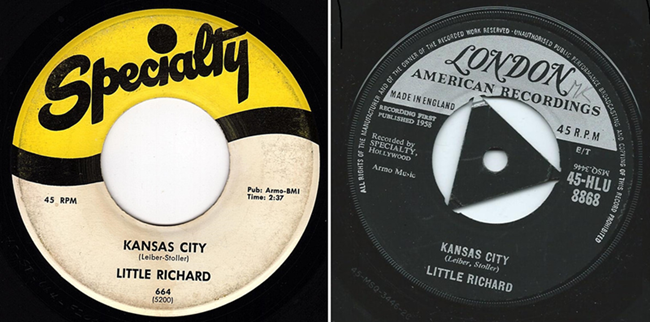
When the group covered Little Richard’s version of Kansas City for Beatles For Sale, which was released in December 1964 on EMI’s Parlophone subsidiary, the company followed established precedent and credited the song to Leiber-Stoller. So did Capitol Records when the track was included on the Beatles VI album, released in the US in August 1965, and again when Kansas City was issued as a US single in October that year, on the Capitol Starline label. In each case, Leiber and Stoller received the composer’s royalties for Kansas City without any complaint from Art Rupe or Venice Music.
That remained the situation until 1975, when Harry Castleman and Walter Podrazik published their book All Together Now – The First Complete Beatles Discography, 1961–1975. Here the Beatles’ recording of Kansas City was for the first time categorised as a “medley”, which according to these writers consisted of the two songs “Kansas City – Jerry Leiber and Mike Stoller – 1:12” and “Hey-Hey-Hey-Hey – Richard Penniman – 1:18”.14 Castleman and Podrazik made this unauthorised change as part of their self-appointed remit to correct what they believed were inaccuracies in the original releases. Their stated intention was that the discography should reflect their own assessment of “what is actually on record (as opposed to what the record says it is)”.15
Was Kansas City as performed by the Beatles really a medley, though, as Castleman and Podrazik asserted? Russ Strathdee has published a useful analysis of this question. He points out that most people mistakenly “perceived the song ‘Hey-Hey-Hey-Hey’ (released in 1958) as an earlier work than ‘Kansas City’ (released in 1959) and as its predecessor (while in fact it was actually the other way around)”. Strictly speaking, then, Little Richard’s November 1955 recording of the song, on which the Beatles’ cover version was based, “could hardly be called a medley, as by definition a medley is a piece composed from parts of existing pieces”, and “when Little Richard was recording ‘Kansas City’, the song ‘Hey-Hey-Hey-Hey’ did not yet exist”.16
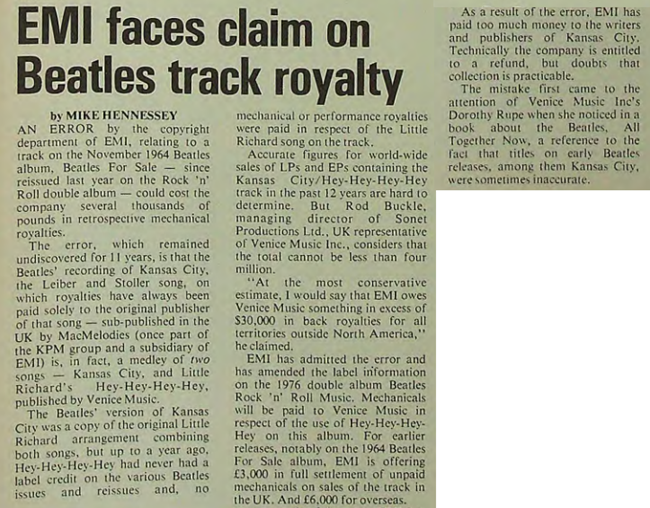
It was Dorothy Rupe – Art’s wife and vice-president of Venice Music – who read All Together Now and spotted its novel description of the Beatles’ Kansas City as a medley. Art Rupe’s eyes must have lit up. Any publisher of a song that appeared on the Beatles’ million-selling albums was due substantial royalties, and since the release of Beatles For Sale over a decade earlier Venice Music had received no payments at all for the Hey-Hey-Hey-Hey component of the newly discovered “medley”. Ignoring the fact that Venice Music had never previously argued that this version of Kansas City was anything other than a Leiber-Stoller composition, whether recorded by the Beatles or by Little Richard himself, the Rupes’ lawyers immediately contacted EMI in the UK and Capitol Records in the US to demand financial compensation.17
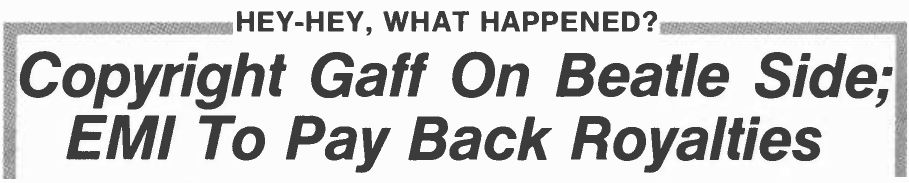
They got their way. The origins and chronology of Little Richard’s recordings of Kansas City and Hey-Hey-Hey-Hey were not understood, and apparently nobody at EMI or Capitol thought to challenge Art Rupe over his failure to raise the issue of the medley earlier. “There was never any question of disputing the validity of the claim,” EMI business manager Laurie Hall told Rolling Stone. “It was just an oversight. It never came to a question of court proceedings. It’s just a matter of figuring out a realistic figure.”18
There was a difference of opinion over this, however. The UK trade publication Music Week quoted a representative of Venice Music as stating: “At the most conservative estimate. I would say that EMI owes Venice Music something in excess of $30,000 in back royalties for all territories outside North America.” That was $175,000 in 2026 money, and of course it didn’t include remuneration for the far larger record sales in the US, where Capitol was engaged in its own bargaining with Venice Music. EMI proposed a more modest assessment of its obligations, offering £3,000 in full settlement of unpaid royalties on sales in the UK and £6,000 for overseas.19 How these negotiations were concluded and in whose favour is unclear. But Art Rupe must have made a lot of money anyway.
Whatever the disagreements between music companies, if anyone had reason to feel hard done by here it was Jerry Leiber and Mike Stoller. They had already been denied the royalty payments they arguably should have received back in 1958 for Hey-Hey-Hey-Hey, which as we’ve seen had in part been lifted without acknowledgement from their own work. And now they missed out again when Art Rupe succesfully claimed further royalties for the same song. But Leiber and Stoller appear to have taken a relaxed attitude towards the loss of half their future earnings from Beatles For Sale. “Since we thought of Richard as the real king of rock’n’roll,” Stoller later explained, “we let it slide and shared the royalties on that one.”20
Not that Little Richard himself was in a position to benefit from Leiber and Stoller’s gesture. As he told Charles White, author of his 1984 biography The Life and Times of Little Richard: “Beginning in 1959, although I had settled my dispute with Rupe for the recording royalties on my biggest hits, he took the position that this release also covered songwriters’ royalties and has refused to pay me any songwriters’ royalties from that day to this one. Consequently, I was forced to institute a federal law suit against him and his companies for the millions of dollars I say he owes me.”21
Unfortunately for Little Richard his case was dismissed, although that didn’t end the dispute, because he appealed against the judgment.22 The issue was resolved only after Michael Jackson acquired the publishing rights to Little Richard’s songs (along with the Lennon-McCartney catalogue) through his purchase of ATV Music in 1985. Jackson then ensured that Richard was fairly compensated, reportedly to the tune of $4 million, following which Rupe was shamed into coughing up $1 million in settlement of the outstanding lawsuit against him.23
If nothing else, the above account does shed additional light on the sharp practices associated with Art Rupe, and indeed with most other record company owners from the 1950s. Usually it was Black artists and songwriters who suffered, but Rupe was prepared to take advantage of anyone when he saw the chance to make a fast buck.24 In future, if people still insist on referring to the Beatles’ recording of Kansas City as a “medley”, perhaps they could at least bear in mind the source of this now official categorisation in a dubious legal case brought by an unscrupulous and money-hungry businessman.
Notes
1. Kansas City was part of the Beatles’ stage repertoire by 1961. See Mark Lewisohn, The Complete Beatles Chronicle (1992) p.363; and Walter Everett, The Beatles as Musicians: The Quarry Men through Rubber Soul (2001) p.96. The song had already been listed for “possible” inclusion in the group’s concerts in the early summer of 1960, even before their first visit to Hamburg. See Mark Lewisohn, The Beatles – All These Years, Volume One: Tune In, Extended Special Edition (2013) p.651. There are recorded performances of Kansas City from September 1962 (at the Cavern, for a Granada TV report), from December 1962 (at the Star-Club, Hamburg), and on five occasions in 1963–4 for the BBC (see the Purple Chick compilation Complete BBC Sessions). A live performance was also filmed in London in October 1964 for broadcast on the US TV show Shindig!
2. The Complete Beatles Chronicle, p.171.
3. The Complete Beatles Chronicle, p.174.
4. Ian MacDonald, Revolution in the Head: The Beatles’ Records and the Sixties, Third Revised Edition (2005), pp.135–6. MacDonald states that the song’s place in the Beatles’ act “didn’t survive into 1963”, and that they “dusted it off” for the September 1964 US concert performance. But Kansas City had featured regularly (see note 1) in “live in the studio” recordings for the BBC, so no dusting off was necessary.
5. In the mid-1970s the composer’s credit was amended to read: “MEDLEY: (a) KANSAS CITY (Lieber/Stoller) (P) 1964 Macmelodies Ltd./KPM. (b) HEY, HEY, HEY, HEY, (Penniman) Venice Mus. Ltd. (P) 1964.” The persistent misspelling of his name must have been a source of irritation to Jerry Leiber.
6. Jerry Leiber and Mike Stoller, Hound Dog: The Leiber & Stoller Autobiography (2009) pp.58–60; David Fricke, ‘Leiber and Stoller: Rolling Stone’s 1990 interview with the songwriting legends’, Rolling Stone, 22 August 2011.
7. Hound Dog: The Leiber & Stoller Autobiography, p.60.
8.. See Mark Ribowsky, The Big Life of Little Richard (2020) pp.63–4. Ribowsky recounts how Rupe abandoned his idea that the follow-up single to Tutti Frutti should be the L.A. recording of Kansas City: “That song, Rupe would have Richard rework again under the title ‘Hey-Hey-Hey-Hey! Goin’ Back to Birmingham’ (with the writing credit solely Richard’s, Leiber and Stoller being stiffed).”
9. The song had been part of Wilbert Harrison’s live act for a number of years. In fact his first record, released on the Rockin’ and De Luxe labels in 1953, was really just K.C. Loving with different lyrics and retitled This Woman of Mine. Leiber and Stoller received no composer’s credit on that recording, although Rockin’ owner Henry Stone did.
10. Excited at the commercial prospects of Harrison’s new disc, Bobby Robinson didn’t wait for records to be pressed and distributed but “hit the road to promote ‘Kansas City’, generously handing out acetates to particularly influential deejays across the country. That was a big mistake. All of a sudden, covers started coming out of the woodwork.” See Bill Dahl, liner notes to Kansas City: The Best of Wilbert Harrison, Sunset Blvd Records (2021).
11. See the Discogs entry. The omission was rectified after Bobby Robinson was sued for copyright infringement. See John Broven, Record Makers and Breakers: Voices of the Independent Rock ’n’ Roll Pioneers (2009) p.347.
12. ‘“Kansas City” keeps trade fever rising’, Billboard, 6 April 1959.
13. See my article ‘Not the “Cunard Yanks”: The real origins of the Beatles’ R&B covers’, Medium, 8 November 2020.
14. Harry Castleman and Walter J. Podrazik, All Together Now – The First Complete Beatles Discography, 1961–1975 (1975), pp.41, 46, 49.
15. The authors state that in compiling their discography they were “forced to disregard a fair amount of information heretofore accepted as true”, such as the use of pseudonyms in songwriting credits. They continue: “Titles, too, were sometimes inaccurate. For example, the song called Kansas City is, in fact, Little Richard’s interpretation of that song, incorporating his own tune Hey-Hey-Hey-Hey! into a medley with the original Kansas City theme” (All Together Now, p.3). This approach conflicts with the principle (adopted by e.g. Discogs) that the primary function of a discography is to document releases by providing the details as they appear on the records themselves, with the correction of any perceived inaccuracies consigned to the accompanying notes.
16. Russ Strathdee, ‘Kansas City – the song’, All about the MUSIC, 6 September 2017.
17. ‘Kansas City’, in Fred Bronson, The Billboard Book of Number One Hits (1985) p.53.
18. Quoted in Bronson, ‘Kansas City’.
19. Mike Hennessey, ‘EMI faces claim on Beatles track royalty’, Music Week, 16 July 1977. For a more detailed report by the same author, see ‘C’right error will cost EMI $$’, Billboard, 16 July 1977.
20. Marc Myers, ‘Anatomy of a song: “Kansas City”’, Wall Street Journal, 6 March 2014.
21. Charles White, The Life and Times of Little Richard: The Authorised Biography (2013) p.94. See also ‘Little Richard sues for royalties’, UPI, 21 June 1984. Along with Rupe’s companies the suit named ATV Music to whom he had sold Venice Music in 1979.
22. ‘Rock ’n’ roll pioneer Little Richard’s $115 million lawsuit…’, UPI, 27 November 1984.
23. The Big Life of Little Richard, pp.190–91. In 1985 Jackson and his attorney “worked out a deal with Richard to return to him not the publishing rights to his songs – as has been inaccurately reported – but a generous sum, estimated at around $4 million, remunerating him for the years of income denied him … and in 1986, Rupe, perhaps feeling a pang of guilt in light of Jackson’s largesse, came to a settlement with Richard for something like $1 million.”
24. In 1971 Rupe sued John Fogerty of the rock group Creedence Clearwater Revival for $500,000 on the grounds that their hit Travelin’ Band “contained substantial material copied from Little Richard’s Good Golly, Miss Molly”, to which Venice Music held the publishing rights. Yet the similarities between those two compositions were certainly no greater than between Kansas City and Hey-Hey-Hey-Hey. (The case was settled out of court.)